
Case Study: ALL-TEST PRO saves $1 million

Skip ahead: Schedule an ALL-Test Pro test today
Key takeaways
- ALL-TEST Pro testing identified a hidden phase unbalance that earlier motor acceptance checks had missed.
- The affected standby motor showed an 11% current unbalance, excessive heat, and electrical vibration, despite the incoming voltage being well balanced.
- The fault was traced to uneven winding construction inside the motor.
- Early diagnosis helped the facility avoid a potential shutdown and generator-bearing damage estimated at more than US$1 million.
- CAW uses ALL-TEST Pro equipment to test new, repaired, stored, and critical motors before hidden faults lead to repeat repairs, unplanned downtime, or equipment damage.
The equipment at risk
The motor formed part of the bearing cooling system for a large generator. The installation used two cooling-pump motors so that one could take over if the other failed.
The standby unit was a:
- 50 HP electric motor
- 3,600 RPM motor
- 480 V motor
- Delta-connected motor
- Generator bearing cooling-pump motor
The team had already installed the standby motor and confirmed its direction of rotation. It remained available until the primary cooling motor failed.
Once called into service, the standby motor displayed several warning signs:
- An 11% current unbalance between phases
- Excessive operating temperature
- Electrical vibration at 120 Hz
- A load reading of approximately 90%
- Less than 0.5% voltage unbalance
The balanced supply voltage helped rule out a serious incoming power-quality problem. The uneven current, heat, and vibration pointed towards an internal motor condition. If the standby motor had also failed, the generator would have needed to shut down within two minutes.
The facility estimated that the resulting outage and possible generator-bearing damage could have cost more than US$1 million.
What did the ALL-TEST Pro find?
ALL-TEST Pro motor circuit analysis compares the electrical characteristics of each motor phase. It can help identify abnormal differences in the windings, rotor, connections, insulation system, or electrical circuit.
In this case, the test readings showed a clear phase-to-phase difference inside the motor. The maintenance team tested two more motors with the same design and similar serial numbers. Those motors produced comparable results, which suggested that the condition extended beyond one isolated unit.
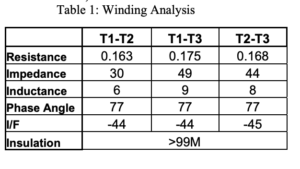
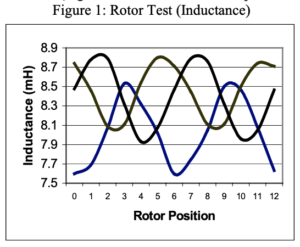
The investigation considered several possible causes:
- Supply-voltage quality
- Incorrect test readings
- Loose or poor connections
- Rotor defects
- Winding faults
- A motor design or manufacturing issue
The team confirmed that the incoming power, test instruments, and external connections were satisfactory. Further investigation traced the unbalance to a change in the manufacturer’s winding process.
The root cause: unequal winding construction
The manufacturer had increased the size of one set of coils to improve the winding’s physical appearance and mechanical construction.
That change affected factors such as:
- The coil’s distance from the rotor
- The dimensions of the coil
- The conductor arrangement
- The electrical inductance of that phase
The motor met the manufacturer’s existing acceptance requirements, but its phases were not electrically balanced under operating conditions. The motor had passed earlier checks. It had been delivered, installed, and kept ready for critical standby service. The hidden winding difference only became clear when the motor was placed under load and then assessed with more detailed motor circuit analysis.
What did early diagnosis prevent?
The facility removed the affected motors from critical service and introduced incoming inspection for new and repaired motors.
ALL-TEST Pro testing gave the maintenance team evidence that the motors contained an internal electrical problem. They could act before another motor entered service and threatened the generator cooling system.
The diagnosis helped the facility:
- Avoid relying on a defective standby motor
- Prevent a possible forced generator shutdown
- Reduce the risk of generator-bearing damage
- Identify other motors with the same design issue
- Improve its acceptance process for new and repaired motors
- Add electrical condition data to its maintenance decisions
The case carries a clear lesson for any industrial operation: a new, repaired, or unused motor can still contain a fault.
How CAW uses ALL-TEST Pro motor testing
CAW uses ALL-TEST Pro equipment to support motor fault finding, condition assessment, incoming inspection, and repair verification. The test takes place while the motor is de-energised. This allows our technicians to assess the electrical circuit without running the motor under production conditions.
Depending on the motor, access point, and type of test, the findings can help us identify or investigate:
- Phase-to-phase unbalance
- Developing winding faults
- High-resistance or loose connections
- Insulation concerns
- Contamination within the winding
- Open circuits
- Rotor abnormalities
- Differences between similar motors
- Changes from previous baseline readings
The test results do not sit in isolation. CAW combines them with visual inspection, insulation testing, mechanical checks, vibration findings, operating information, and other relevant diagnostic methods.
This gives you a clearer basis for deciding whether to monitor, repair, rewind, refurbish, or replace the motor.
Test a new motor before you install it
A new motor can contain a manufacturing, winding, connection, or rotor defect.
Incoming motor inspection gives you an independent view of its electrical condition before you:
- Accept delivery
- Move it to a remote plant
- Install it in a difficult-to-access location
- Allow the warranty period to pass
- Place it into critical standby service
This matters when the motor has a long replacement lead time or supports equipment that can stop your plant.
Verify a repaired motor before returning it to service
A repaired motor should undergo proper testing before it returns to your operation. Motor circuit analysis can help verify whether the phases are electrically consistent and whether there are signs of an unresolved winding, connection, insulation, or rotor problem. This reduces the risk of transporting, installing, and commissioning a motor that still requires further attention.
CAW can also carry the process through from diagnosis to repair, rewinding, balancing, refurbishment, and final testing where required.
Investigate recurring motor problems
Repeated motor failure often points to an underlying condition that has not yet been addressed.
Arrange further testing when a motor:
- Continues to run hot
- Draws uneven phase current
- Trips without a clear cause
- Develops unexplained electrical vibration
- Fails repeatedly in the same application
- Performs differently from an identical motor
- Returns from repair with the same symptoms
- Shows abnormal readings during routine maintenance
Detailed testing helps separate an internal motor fault from problems elsewhere in the circuit or driven equipment.
Build baseline readings for condition monitoring
A baseline test records the motor’s electrical condition at a known point in time.
CAW can compare future results against that baseline to identify changes. This helps your maintenance team see whether the motor remains stable or whether a fault may be developing.
Baseline motor testing is particularly useful for:
- Critical production motors
- Standby and emergency equipment
- High-value motors
- Long-lead-time motors
- Motors in remote locations
- Equipment exposed to moisture, dust, chemicals, or heat
- Motors with a history of repeat failure
Trend data also helps you plan maintenance around shutdowns rather than waiting for the motor to determine your schedule.
When should you arrange motor circuit analysis?
Contact CAW when:
- You receive a new critical motor
- A repaired or rewound motor returns to your site
- A standby motor has remained in storage
- A motor runs hotter than expected
- You measure uneven phase current
- A motor develops unexplained vibration
- The same motor or application fails repeatedly
- You need baseline readings for condition monitoring
- You are preparing for a planned shutdown
- You need evidence before deciding whether to repair or replace
You do not need to wait for a breakdown. Testing while the motor remains de-energised can give you time to plan the next step.
Arrange ALL-TEST Pro motor testing with CAW
CAW combines advanced motor testing with more than 50 years of electromechanical repair experience.
We can assess your motor, explain the findings, and advise you on the next step. Where the motor requires attention, our teams can support the repair, rewind, refurbishment, balancing, and testing process.
Contact CAW about testing:
- New motors before acceptance or installation
- Repaired motors before commissioning
- Stored or standby motors
- Motors showing abnormal heat, current, or vibration
- Critical assets included in your shutdown or maintenance programme
CAW serves industrial clients from our facilities in Cape Town, South Africa, and Swakopmund, Namibia.
South Africa: +27 (0) 21 556 1488
Email: info@capearm.co.za
Namibia: +264 81 674 6815
Email: info@caw-ems.com
FAQs
What is motor phase unbalance?
Motor phase unbalance means the electrical characteristics of one or more phases differ from the others. The difference may affect the current drawn by the motor and can contribute to excessive heat, vibration, reduced performance, and winding stress.
Can a new motor have an internal electrical fault?
Yes. Manufacturing differences, winding defects, poor connections, damaged conductors, and rotor problems can affect a new motor. Incoming inspection helps you identify these concerns before installation.
What does ALL-TEST Pro motor testing detect?
ALL-TEST Pro motor circuit analysis helps identify abnormal phase readings and signs associated with winding, connection, insulation, contamination, and rotor problems. CAW interprets the findings alongside other inspection and test results before recommending action.
Does the motor need to run during the test?
No. Motor circuit analysis takes place while the motor is de-energised. This makes it suitable for stored motors, standby equipment, incoming inspection, shutdown testing, and motors that cannot safely run.
Can CAW test repaired and rewound motors?
Yes. CAW can test repaired and rewound motors before they return to service. The results help verify their electrical condition and identify concerns that may require further investigation.
Which industries benefit from motor circuit analysis?
Industries that depend on critical motors benefit most, including power generation, mining, water and wastewater, manufacturing, food processing, marine, fishing, rail, oil and gas, and general process industries.
Source and use-case note
This article draws on a published ALL-TEST Pro case study involving a generator bearing cooling-pump motor. CAW did not perform the original diagnosis. We use the case to demonstrate the type of hidden electrical condition that motor circuit analysis can identify and how CAW can apply this testing capability for industrial clients in South Africa and Namibia.